GPU & infrastructure / 2025–2026 SERIES
NVIDIA Rubin Explained: AI Infrastructure in 2026
Why the 2026 Rubin announcement matters beyond the GPU—and what to ask before planning an upgrade.
Milestone covered:
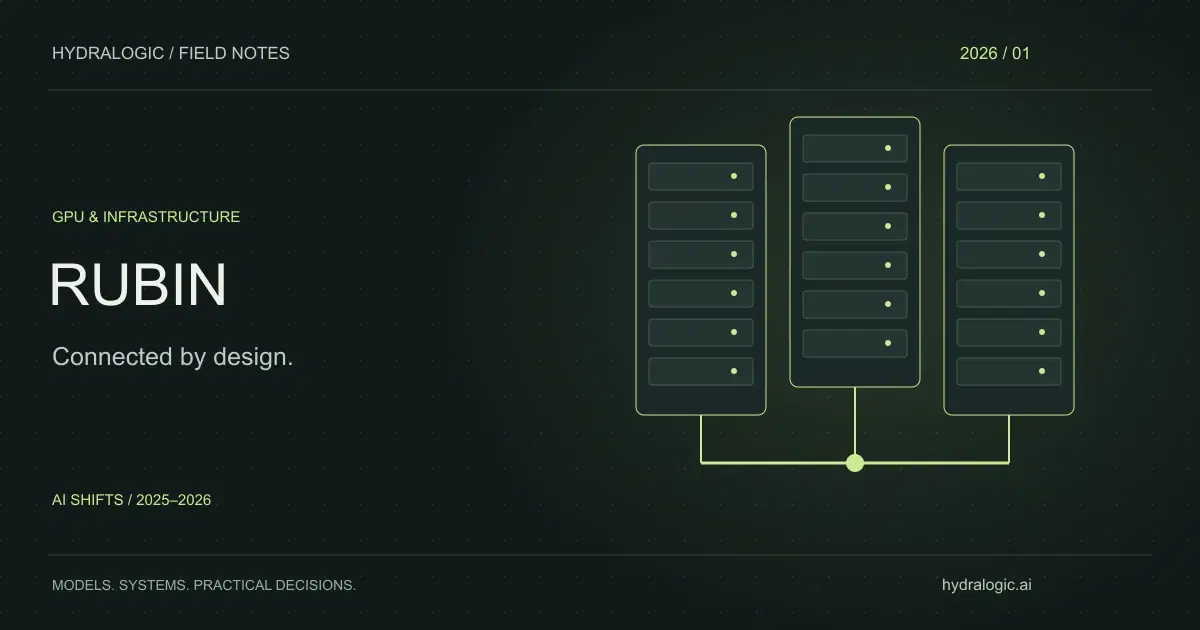
A faster chip is useful. A system that keeps all its chips busy is often more useful. NVIDIA’s Rubin announcement is a good example of why AI infrastructure has become a whole-system problem.
What changed in 2026
On January 5, NVIDIA introduced a Rubin platform built around six chip types: a Vera CPU, Rubin GPU, NVLink 6 switch, ConnectX-9 network adapter, BlueField-4 processor, and Spectrum-6 Ethernet switch. The aim was to improve how the components work together when training and serving AI models. NVIDIA’s announcement scheduled partner products for the second half of 2026; it was not evidence that every cloud customer could rent them immediately. Read NVIDIA’s announcement.
Why the connections matter
Imagine a busy kitchen. Adding a faster oven helps only if ingredients arrive on time and meals can leave the kitchen. AI systems have similar dependencies: processors need data, and multiple processors need to exchange information.
For a team choosing infrastructure, our takeaway is to look at the slowest part of the application. A slow document search or overloaded database can still dominate the response time of an otherwise fast AI service.
A useful upgrade conversation
Start with three questions:
- Where does the current application spend its time: retrieval, model processing, generation, or external tools?
- What happens when many users arrive together?
- What does one successfully completed task cost, including retries and idle capacity?
Ask a provider to run your workload with your model, input sizes, and quality target. Record both average performance and the slow responses that users actually notice. Keep the application unchanged during the first comparison so you can tell what the hardware changed.
Our practical recommendation
Create a one-page baseline before requesting an upgrade. Include request volume, acceptable wait time, failure rate, and monthly cost. Treat a new platform as a candidate to test against that baseline. The useful result is a better service for your users, with an operating cost your team understands.
For a related constraint, read our guide to HBM4 memory.
Source note: launch facts are linked to the original announcements or documentation. Recommendations are Hydralogic’s analysis; this article does not report an independent product benchmark.
Explore the full collection ↗