GPU & infrastructure / 2025–2026 SERIES
AMD MI350 GPUs: Memory, ROCm & Deployment Choices
What the June 2025 launch means for teams comparing AI infrastructure.
Milestone covered:
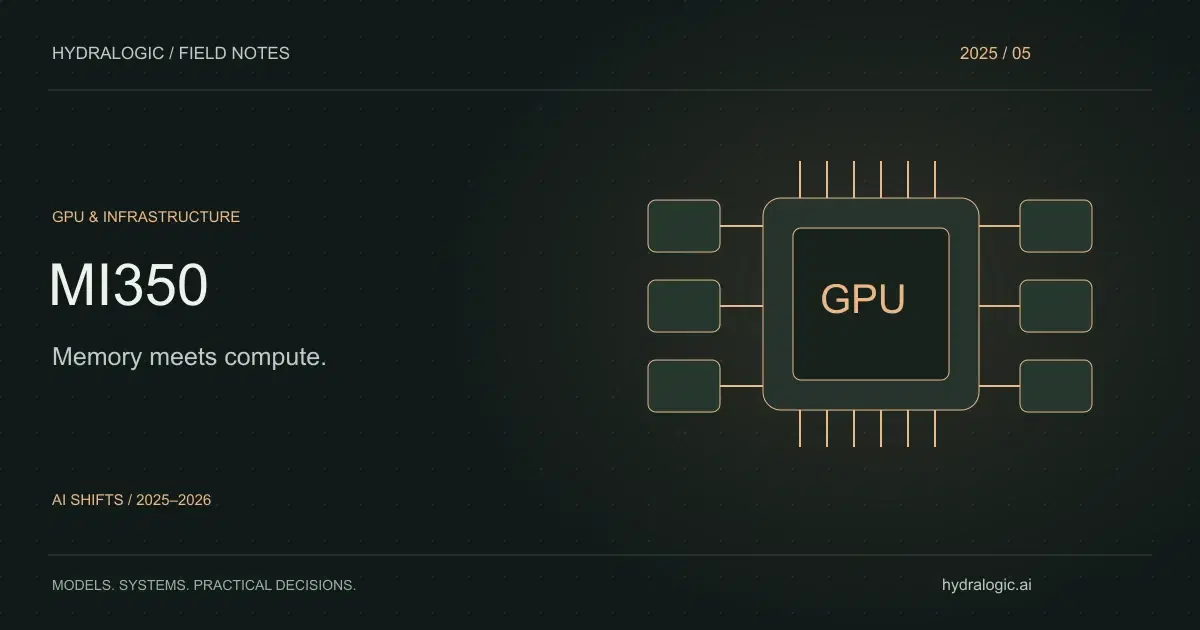
More choice in AI hardware is useful when teams can compare it fairly. AMD’s MI350 launch made that comparison more interesting, especially for workloads that need substantial memory.
What launched
AMD introduced the Instinct MI350 series on June 12, 2025. The MI350X and MI355X use the CDNA 4 architecture, with 288 GB of HBM3E memory per GPU and a published memory bandwidth of 8 TB/s. AMD also discussed a preview of ROCm 7, its software platform for accelerated computing. Read AMD’s technical overview.
Those specifications are useful starting points. They do not tell you the speed or cost of your complete application.
Why memory makes the shortlist
In a hardware evaluation, memory capacity influences which configurations are practical to test. A model that needs several devices introduces a different operating problem from one that fits within a smaller configuration.
Our advice is to write down the application’s memory needs before comparing device names. Include the model, the inputs it receives, and the traffic you expect to serve at once.
The software question is just as important
Before a production commitment, have the team run the exact serving framework and model version it expects to operate. A successful installation is only the first check.
Try the ordinary operational tasks too: starting a new instance, collecting performance data, restarting after a failure, and rolling back an update. Record any changes needed in the application or deployment scripts.
For a fair comparison, hold the quality target and workload constant. If one run uses a different model precision or shorter inputs, explain that difference next to the result.
Our practical recommendation
Use a small compatibility trial before a large performance exercise. Confirm that the software behaves correctly, then measure completed work per unit of cost at realistic load. Include engineering time in the decision. The best option for a team is the one it can operate successfully, with a clear reason for choosing it.
For help defining the trial, see AI, ML and MLOps advisory.
Source note: launch facts are linked to the original announcements or documentation. Recommendations are Hydralogic’s analysis; this article does not report an independent product benchmark.
Explore the full collection ↗