GPU & infrastructure / 2025–2026 SERIES
HBM4 Explained: Why GPU Memory Matters for AI
The 2025–2026 memory milestones that explain why GPU performance is about more than arithmetic.
Milestone covered:
GPU headlines often focus on how much calculation a chip can perform. There is another important question: how quickly can it get the information needed for those calculations?
That is why high-bandwidth memory, usually shortened to HBM, deserves attention.
Two milestones to understand
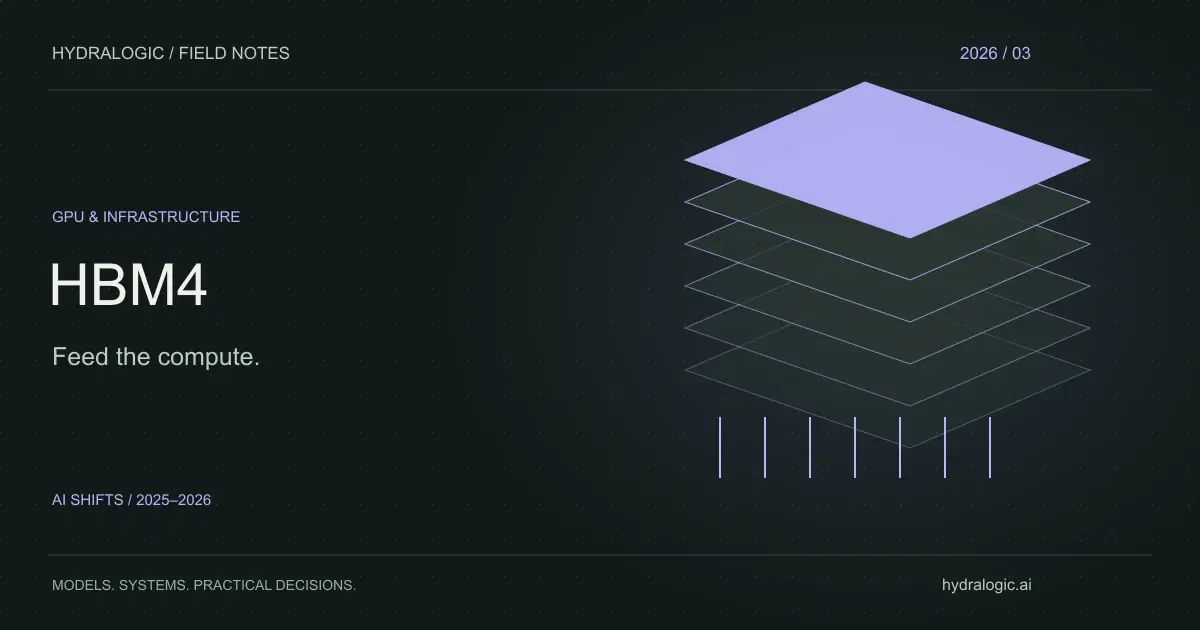
On September 12, 2025, SK hynix announced that it had completed HBM4 development and prepared its mass-production system. Its design used 2,048 data connections, twice the previous generation’s count. SK hynix’s announcement explains the change.
On March 16, 2026, Micron reported that volume shipments of its 36 GB, 12-layer HBM4 had begun in the first quarter, with the product designed for NVIDIA Vera Rubin. This was a shipment milestone for a memory component, not a statement that every Rubin system was available. Micron’s announcement.
Capacity and bandwidth are different
Think of capacity as the size of a workbench and bandwidth as how quickly materials reach it. A larger workbench fits more work. Faster delivery reduces time waiting for materials. An AI application can need either improvement, or both.
For an infrastructure review, separate these questions. Does the workload run out of memory? Or does it fit comfortably but spend too much time moving data? The answers lead to different experiments.
What to ask in a benchmark
Use representative input lengths and realistic numbers of simultaneous users. Ask the team running the test to record peak memory use, response time, and completed requests. Then repeat at a higher load.
Avoid comparing only the largest model that can start successfully. A useful deployment also needs room for normal traffic, temporary allocations, and recovery when something goes wrong.
Our practical recommendation
Add two separate lines to your infrastructure requirements: required memory capacity and measured serving performance. Keep both tied to the actual application. HBM4 is a significant component advance, but its value to your business depends on the complete server and the workload running on it.
Read our AMD MI350 overview for another example of memory shaping hardware decisions.
Source note: launch facts are linked to the original announcements or documentation. Recommendations are Hydralogic’s analysis; this article does not report an independent product benchmark.
Explore the full collection ↗