AI models / 2025–2026 SERIES
GPT-5 Reasoning: Lessons for AI Model Evaluation
What the 2025 release taught us about balancing answer quality, waiting time, and cost.
Milestone covered:
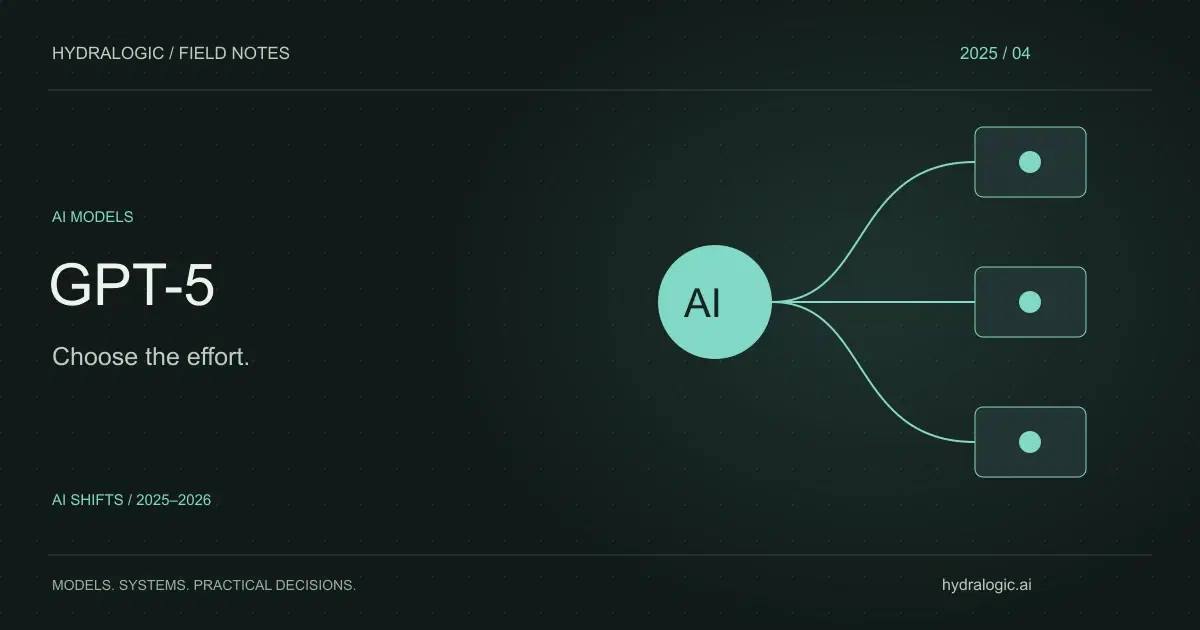
One of the useful lessons from GPT-5 is that a model’s effort can be part of application design. Different tasks deserve different amounts of work.
The 2025 milestone
GPT-5’s August 2025 API generation supported configurable reasoning effort, with minimal, low, medium, and high settings. OpenAI’s model documentation also describes tool calling and structured outputs. Those features gave developers several controls for building workflows around the model. Official GPT-5 documentation.
This article looks back at that release. The documentation now identifies GPT-5 as a previous, deprecated model, so use the current model catalog when selecting a model for a new application.
Why the idea still matters
Consider two requests in a support system. One asks the assistant to put a ticket into a category. The other asks it to reconcile conflicting evidence from several incident reports. Our recommendation is to evaluate those tasks separately instead of giving every request the same configuration.
The business question is whether extra model work produces a better result that is worth the additional wait and cost. A polished explanation is not enough evidence; the answer must satisfy the task’s acceptance criteria.
A small experiment your team can run
Collect a representative set of examples with expected outcomes. Include easy requests, ambiguous requests, and requests where the correct response is to ask for more information.
Try two supported configurations on the same examples. Compare:
- Correctness against a written scoring guide.
- Time until a usable answer is ready.
- Total cost, including retries and failed attempts.
- The amount of human correction needed.
Review the failures before averaging the scores. A configuration that works well on routine questions may still be unsuitable for an important exception.
Our practical recommendation
Keep model choice, effort settings, and evaluation results together in a short decision record. When the model changes, rerun the same examples. This turns upgrades into a repeatable engineering activity instead of a reaction to each launch announcement.
Our AI assessment service starts with this kind of decision and the evidence needed to make it.
Source note: launch facts are linked to the original announcements or documentation. Recommendations are Hydralogic’s analysis; this article does not report an independent product benchmark.
Explore the full collection ↗