AI models / 2025–2026 SERIES
Claude Opus 4.6: Coding, Context & Agent Workflows
A simple guide to the February 2026 release and how to keep longer AI workflows reviewable.
Milestone covered:
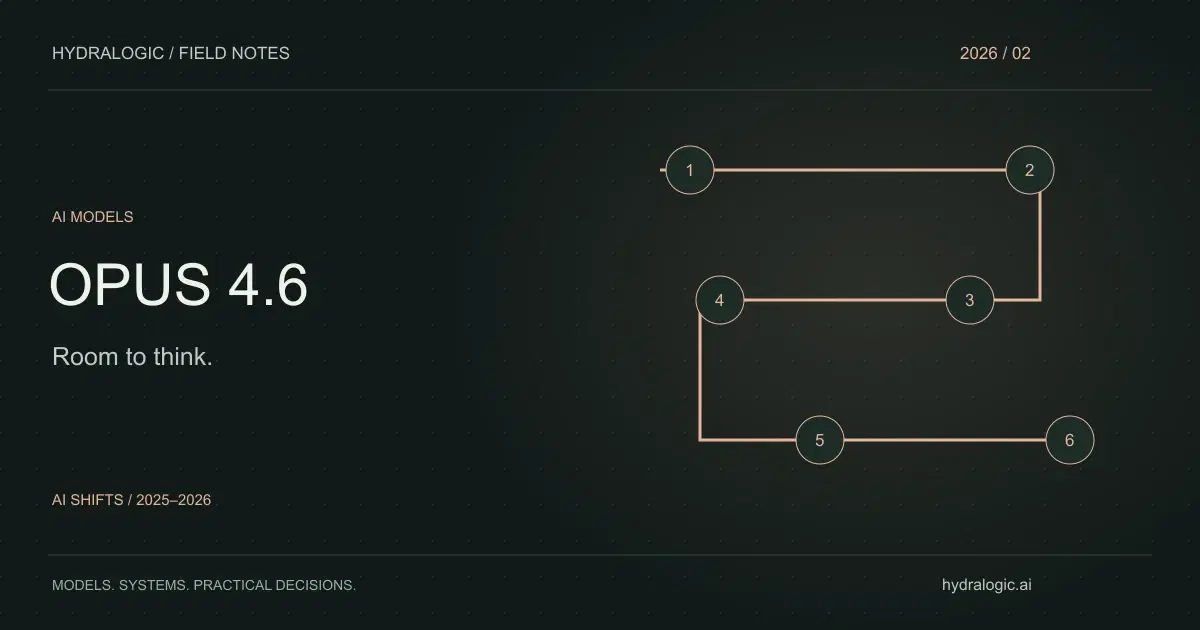
Some tasks need more than a good answer. They need a sequence of useful steps: inspect a codebase, compare options, make a change, and check the result. That is the kind of work the Claude Opus 4.6 release brought into focus.
What Anthropic announced
Anthropic released Opus 4.6 on February 5, 2026. The company described improvements in coding, code review, debugging, and sustaining longer agent tasks. It also introduced a one-million-token context window in beta for Opus, plus adaptive thinking and effort controls. These were launch capabilities and vendor assessments, not a promise that every task would succeed. Read the release.
Context is the material a model can work with during a request. A larger allowance can help with larger projects, but providing more material does not by itself establish which source is correct or which action is allowed.
What this means for a team
Our recommendation is to design a longer task as a series of reviewable outputs. For example, a coding assistant could first produce a map of the relevant files, then propose a change, then prepare a patch and test report.
The engineer can review each output without reading every intermediate interaction. That makes it easier to find a wrong assumption before it spreads into several files.
Start with one bounded task
Choose a maintenance task with an existing test suite. Write down:
- The files or systems the assistant may change.
- The evidence required to call the work complete.
- The point where it should stop and ask for review.
- The person who owns the final decision.
Keep the first trial separate from automatic deployment. Compare the time spent reviewing and correcting the result with the time spent doing the task normally. A quick draft that takes longer to verify is not yet a productivity improvement.
The lesson worth keeping
As models become better at sustained work, task design becomes more valuable. Clear inputs, small checkpoints, and a visible finish line help your team benefit from the capability without losing track of the work. This is a retrospective on the February release, rather than a claim that it is today’s newest Claude model.
Explore technical coaching for putting these habits into a team’s workflow.
Source note: launch facts are linked to the original announcements or documentation. Recommendations are Hydralogic’s analysis; this article does not report an independent product benchmark.
Explore the full collection ↗